Songs
أغدًا ألقاك Aghadan Alqak (Will I Meet You Tomorrow?)
- Year
- 1971
- Lyricist
- Al-Hadi Adam
- Composer
- Mohammed Abdel Wahab
- Maqam
- Ajam
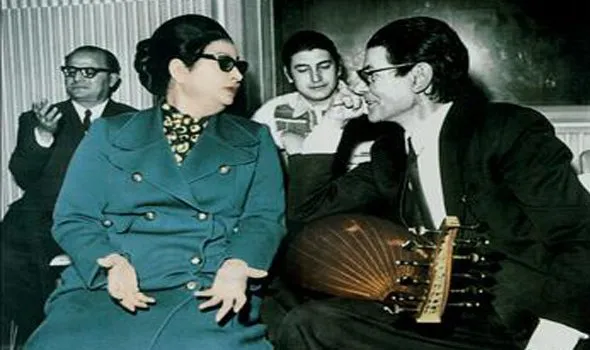
Short excerpts are quoted here for commentary and study; the complete lyrics remain under copyright. The annotations and the essay below tell the whole story.
Lines marked with a gold ornament carry a note — select one to read it.
أغدًا ألقاك؟ يا خوف فؤادي من غدِ
A-ghadan alqak? Ya khawfa fu'adi min ghadi
Will I meet you tomorrow? How my heart fears its tomorrow —
A song that opens on a question mark. Nearly all of Umm Kulthum's great qasidas look backward — at ruins, at memory, at a love already lived — but "Aghadan Alqak" is built entirely on anticipation: the meeting has not happened yet, and may not. The interrogative first word, hanging unresolved, gives the whole evening its engine of suspense.
She premiered the song in 1971 at the Qasr al-Nil hall in Cairo, in her seventies and nearing the end of the road: illness would halt her concerts the following year, and she died in 1975. "Aghadan Alqak" stands among the last major premieres of her half-century career — which lends its question an unintended poignancy, a singer asking "will I meet you tomorrow?" as the tomorrows ran out.
يا لشوقي واحتراقي في انتظار الموعدِ
Ya la-shawqi wa-htiraqi fi-ntizari l-maw'idi
oh, my longing, my burning, as I wait for the appointed hour
"Longing and burning in wait for the appointed hour": the poem is by al-Hadi Adam, the Sudanese poet and educator, chosen by Umm Kulthum from verse presented to her during her 1968 visit to Sudan — one of the fundraising journeys she made across the Arab world after 1967. It is the only lyric of his she ever sang, and it made him famous from ocean to gulf.
آه كم أخشى غدي هذا وأرجوه اقترابا
Ah kam akhsha ghadi hadha wa-arjuhu qtiraba
Ah, how I dread this tomorrow of mine, yet plead for it to come near —
Dread and plea in one breath: the lover fears tomorrow and begs it to hurry. This is the psychology of anticipation rendered with clinical honesty — hope experienced as a kind of fear. Umm Kulthum, then in her seventies, sang the trembling of a young lover awaiting a first meeting, and made the paradox utterly believable.
كنت أستدنيه لكن هبته لما أهابا
Kuntu astadnihi lakin hibtuhu lamma ahaba
I kept beckoning it closer, then trembled when it came
"I kept beckoning it closer, then trembled when it came" — the couplet turns on the courtly verb haba, to stand in awe. Abdel Wahab sets the fearful text, counterintuitively, in maqam Ajam — the bright, major-scale mode — so the music shines with exactly the hopeful light the words distrust. The friction between radiant melody and anxious poem is the composition's masterstroke.
هذه الدنيا كتاب أنت فيه الفكرُ
Hadhihi d-dunya kitabun anta fihi l-fikru
This world is a book, and you are the thought within it;
The poem's most quoted movement begins here: the world as a book whose every thought is the beloved. After the fever of waiting, the anaphora of "hadhihi d-dunya" (this world...) arrives like a creed recited, and Abdel Wahab broadens the melody to match — the intimate question of the opening enlarged into cosmology.
هذه الدنيا ليالٍ أنت فيها العمرُ
Hadhihi d-dunya layalin anta fiha l-'umru
this world is nights, and you are the life within them
The parallel completes itself: the world is nights, and the beloved is the life — the very lifetime — inside them. In concert this couplet drew storms of applause, and she would re-enter it repeatedly, re-balancing "book" against "nights," "thought" against "life," like a jeweler turning a stone.
What this song means
Umm Kulthum’s greatest qasidas almost all face backward — toward ruins, toward memory, toward loves already lived and lost. “Aghadan Alqak” is the great exception: a song that faces forward, built entirely on the electricity of a meeting that has not yet happened. Its first word is a question — Will I meet you tomorrow? — and the question is never answered. Premiered in 1971 at the Qasr al-Nil hall in Cairo, it stands among the last major works she ever introduced, and it has only grown in stature since: the definitive Arabic song of anticipation.
The poem’s route to her stage crossed a border her repertoire had rarely crossed. After the 1967 defeat, Umm Kulthum spent her energies on fundraising concerts across the Arab world, and her 1968 journey to Sudan brought her the verse of al-Hadi Adam, a Sudanese poet and educator then little known outside his country. From the poetry presented to her she chose this meditation on the eve of a meeting — the only lyric of his she would ever sing. One song sufficed: it carried his name into every Arab household and remains the proudest Sudanese contribution to the Kulthum canon, a genuinely pan-Arab collaboration between an Egyptian voice, an Egyptian composer, and a poet of the Nile’s other republic.
What al-Hadi Adam understood, and what the song renders with almost clinical honesty, is that hope is a species of fear. The lover dreads tomorrow and begs it to hurry; beckons the appointed hour closer, then trembles when it approaches. There is no betrayal in this poem, no rival and no ruin — the only antagonist is time, experienced from the rare side: not the time that erodes what happened, but the time that withholds what might. Every listener who has waited for a decisive tomorrow — a reunion, a verdict, a wedding, a return from war — has been handed their own portrait.
Mohammed Abdel Wahab’s setting makes a masterstroke of contradiction. For this most anxious of texts he chose maqam Ajam — the bright, major-scale mode, the most openly optimistic color in the Arabic system — so that the music glows with precisely the confidence the words cannot feel. The friction between radiant melody and fearful poem is the engine of the performance: Umm Kulthum, in her seventies, sang a young lover’s trembling with a voice that had outlasted kings, and when she reached the famous double summit — “this world is a book, and you are the thought within it; this world is nights, and you are the life within them” — audiences answered with storms that pulled her back into the couplet again and again.
Time gave the song its final meaning without asking anyone’s permission. Illness ended her concerts the year after the premiere; she died in February 1975. “Aghadan Alqak” thus closes her career on an open question — a singer asking “will I meet you tomorrow?” precisely as the tomorrows ran out. Perhaps that is why the song occupies so tender a place among her admirers. The great voice of memory spent her last strength on a hymn to expectation, and left the meeting forever pending: the concert ends, the question doesn’t.
Related songs
All songsEnta Omri (You Are My Life) إنت عمري
1964 · Maqam Kurd
Enta Omri (1964): Umm Kulthum meets Mohammed Abdel Wahab in the 'meeting of the clouds' — history, maqam Kurd, and the meaning of her most famous love song.
Daret El Ayyam (The Days Turned) دارت الأيام
1970 · Maqam Rahat al-Arwah
Daret El Ayyam (1970): Mamoun al-Shinnawi and Mohammed Abdel Wahab's late masterpiece for Umm Kulthum — quarrel, reunion, and dawn after estrangement.
Ya Msaharni (You Who Keep Me Sleepless) يا مسهرني
1972 · Maqam Rast
Ya Msaharni (1972): Sayed Mekawy's only melody for Umm Kulthum and Ahmed Rami's last lyric — a sleepless reproach in maqam Rast. Excerpts and commentary.
Fakkarouni (They Reminded Me) فكروني
1966 · Maqam Rast
Fakkarouni (1966): a chance remark rekindles a buried love — Abdel Wahab's maqam Rast setting, the famous one-word hook, meaning & translation of Umm Kulthum's classic.
From the wiki
All articlesConcepts
Where to Start with Umm Kulthum: A Listener's Guide
New to Umm Kulthum? A step-by-step listening guide: which songs to start with, from Enta Omri to Al-Atlal, and how to enjoy her hour-long live tarab recordings.
History
The Death and Funeral of Umm Kulthum
Umm Kulthum died on 3 February 1975. Her final illness, the Cairo funeral that drew millions, the seized bier, her Basatin mausoleum, and the Arab world's mourning.
History
The Complete Umm Kulthum Song List
The complete Umm Kulthum songs list, decade by decade from 1924 to 1973: every recorded song with its year, lyricist, and composer — nearly 320 works in all.