Ask what makes an Umm Kulthum song sound the way it does — why one aches, another glows, a third seems suspended in mid-air — and sooner or later the answer arrives at a single word: maqam. The maqam system is the melodic grammar of Arab music, and a listener needs no theory to feel it. But a little theory makes the feeling legible.
More Than a Scale
A maqam (plural maqamat) is often translated as “scale,” and that is the least of what it is. Yes, each maqam specifies a set of pitches. But it also carries rules of behavior: which notes to dwell on, which to pass over lightly, where a phrase should come to rest, in what order the melody should unfold its territory. That unfolding has its own name — sayr, literally “the walk” or “the path.” Two maqams can share most of their notes and remain unmistakably different, the way two people can walk the same street with entirely different gaits.
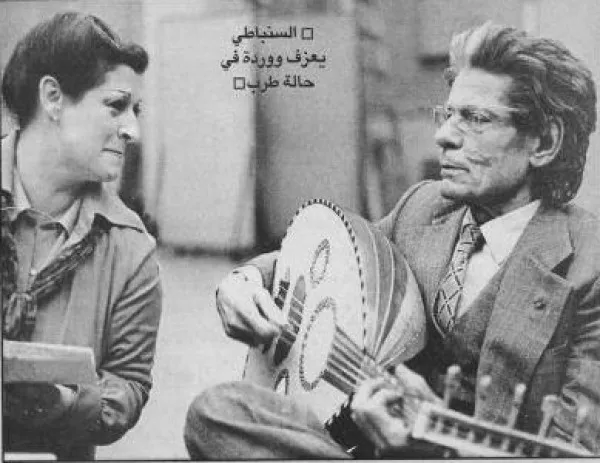
Because of the sayr, a maqam is closer to a personality than to a scale. Composers of Umm Kulthum’s era — Riad al-Sunbati above all — were masters of this grammar, able to honor a maqam’s character for an hour while modulating away to neighboring maqamat and returning home with a sense of arrival that audiences greeted like the resolution of a plot.
Between the Notes
The most famous feature of the system is the interval Western pianos cannot play: the so-called quarter tone. Arab music divides the octave more finely than the Western twelve-semitone grid, so certain notes fall in between the piano’s keys — most characteristically the “half-flat,” about a quarter tone lower than the natural note. These are not out-of-tune notes; they are precisely placed, and to an ear raised on this music their absence is what sounds wrong. Quarter tones are why the violin, oud, nay, and qanun — instruments that bend or place pitch freely — form the heart of the ensemble, and why the fixed-pitch piano never colonized this repertoire.
Four Maqams from the Archive
The songs in this archive make the abstractions audible. Four maqams, four temperaments.
Rast is often called the father of the maqamat: grounded, warm, upright, with a signature half-flat third that softens its confidence into tenderness. It is the maqam of nobility without stiffness — a natural fit for the affectionate playfulness of Ghanni Li Shwayya, where Zakariyya Ahmad’s melody keeps its dignity even while it smiles.
Kurd contains no quarter tones at all, which gives it a clean, modern profile close to what Western ears know as the Phrygian mode. Its color is plaintive and intimate — a low flame rather than a blaze. It is the maqam of Enta Omri, where Mohammed Abdel Wahab used its directness to make a vast love song feel spoken into one person’s ear.
Huzam belongs to the Sikah family, whose home note is itself a half-flat — the tonal ground is a quarter tone off the Western grid, so the whole maqam seems to hover. Its character is poignant, exalted, faintly otherworldly, which is why it suits both religious repertoire and grief-struck poetry. It is the maqam of Al-Atlal, and much of that song’s floating, elegiac quality is Huzam doing its quiet work.
Farahfaza is a low-lying relative of the minor-sounding Nahawand family, its name borrowed from Persian and suggesting “increaser of joy.” The label is half-true: its color is festivity shadowed by melancholy, celebration at night. Baligh Hamdi chose it for Alf Leila wa Leila, where it gives a song about boundless love the glitter and dark of the thousand-and-one nights themselves.
Maqam and Tarab
Why does any of this matter to a listener? Because the maqam system is the engine of tarab — the state of musical ecstasy that this whole tradition exists to produce. Tarab is not a private swoon; it is a public feedback loop. The singer bends a phrase deeper into the maqam, the audience cries out, the cry licenses a further bending, and the song’s clock stops mattering.
The maqam makes this possible by giving performer and audience a shared map. Everyone in the hall knows, without schooling, where the melody is supposed to rest and what it would mean to delay that rest one more time. Umm Kulthum’s genius lay in how long she could hold the tension of the map — repeating a line five, ten, fifteen ways, each repetition exploring another fold of the maqam — before granting the resolution. The theory has a vocabulary, but the audience’s roar at the moment of arrival is the only definition of maqam that finally matters.