For roughly four decades, the Arab world kept a shared appointment. On the first Thursday of the month, through the concert season, Umm Kulthum sang in Cairo and the radio carried her live to anyone with a receiver — which, as the century went on, meant nearly everyone. No broadcast institution in the region has ever matched it: not a program but a ritual, obeyed from the Atlantic coast of Morocco to the Gulf.
A Date the Whole Arab World Kept
The habit took shape after Egyptian state radio began broadcasting in 1934 and made Umm Kulthum’s monthly concert a fixture of its schedule. Thursday evening was the week’s threshold — the night before Friday, the day of rest — and the first Thursday of the month became hers.
The stories about those nights are told so widely, in so many countries, that they long ago passed from anecdote into collective memory: streets emptying as the hour approached; café owners hauling their radio sets onto the pavement, chairs arranged around them like pews; taxi drivers parked mid-route, engines off; family visits scheduled around her, not the other way round. Politicians learned not to schedule speeches against her. Across borders that were hardening politically, the concerts remained a single shared room — the rare institution every Arab capital entered at the same hour.
The Shape of an Evening
A first Thursday concert bore no resemblance to a modern variety program. The evening was built from waslahs — long performance segments — and each waslah held exactly one song. Three songs could fill a night that stretched from mid-evening deep past midnight, because a “song” in this form was not a three-minute object but a territory to be explored.
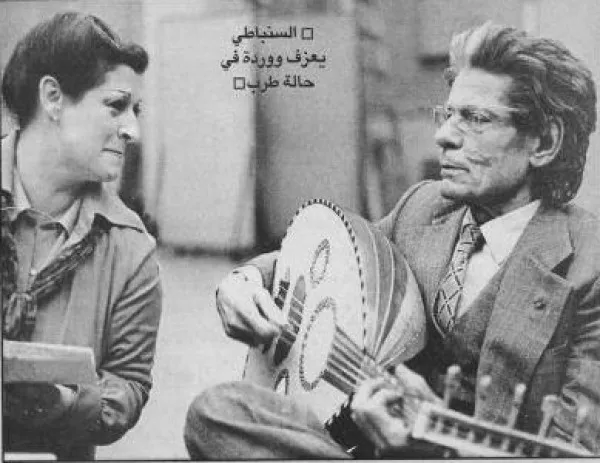
Each waslah opened with the orchestral muqaddima, the firqa planting the melody and the maqam in the hall’s ear. Then the voice entered, and the real work began: verse by verse, Umm Kulthum unfolded the text — a colloquial lyric by a poet like Ahmed Rami, or a towering classical qasida — over thirty, forty, sixty minutes or more. Songs written in this mold, like Hayyart Albi Maak or Al-Atlal, both composed by Riad al-Sunbati, were designed as journeys: stations of tension and release laid out in advance, with room left for the singer to linger wherever the night demanded.
The Audience as Co-Author
And the night did demand. The defining fact of these concerts is that no two performances of the same song were alike, because the audience was inside the music. When a line landed, the hall erupted — and the eruption was a request. Umm Kulthum would circle back and deliver the line again, differently: another ornament, another register, a harder lean into the maqam’s most aching notes. A single verse might return five or ten times, each pass an escalation, the crowd’s cries of approval functioning as a running negotiation between singer and hall.
These were the “endless encores” that baffled first-time foreign listeners and defined the form for everyone else. They were not repetition; they were composition in real time, the pursuit of tarab — collective musical ecstasy — by iteration. It is why her live recordings differ so much from studio versions, and why devotees argue over which night’s Enta Omri is the true one. The clock had no authority in the hall. The song ended when the state it was building had been achieved, and not before.
The Ritual and Its Afterlife
The first Thursday concerts turned a singer’s schedule into civic architecture. A month in Cairo — and in Beirut, Baghdad, Tunis, Khartoum — had a shape, and she was part of the shape. When war came in 1967, the same monthly machinery converted almost overnight into a national fundraising instrument, because the audience assembled itself; it always had.
Illness thinned the schedule in the early 1970s, and her last full concert came in 1972. But the appointment outlived the singer. Arab radio stations went on replaying her concerts in the first days of the month for decades — many still do — so that listeners born long after 1975 acquired the reflex their grandparents had: when that orchestral introduction surges out of the static on a Thursday evening, you stop what you are doing. The seats in the hall are gone. The appointment stands.